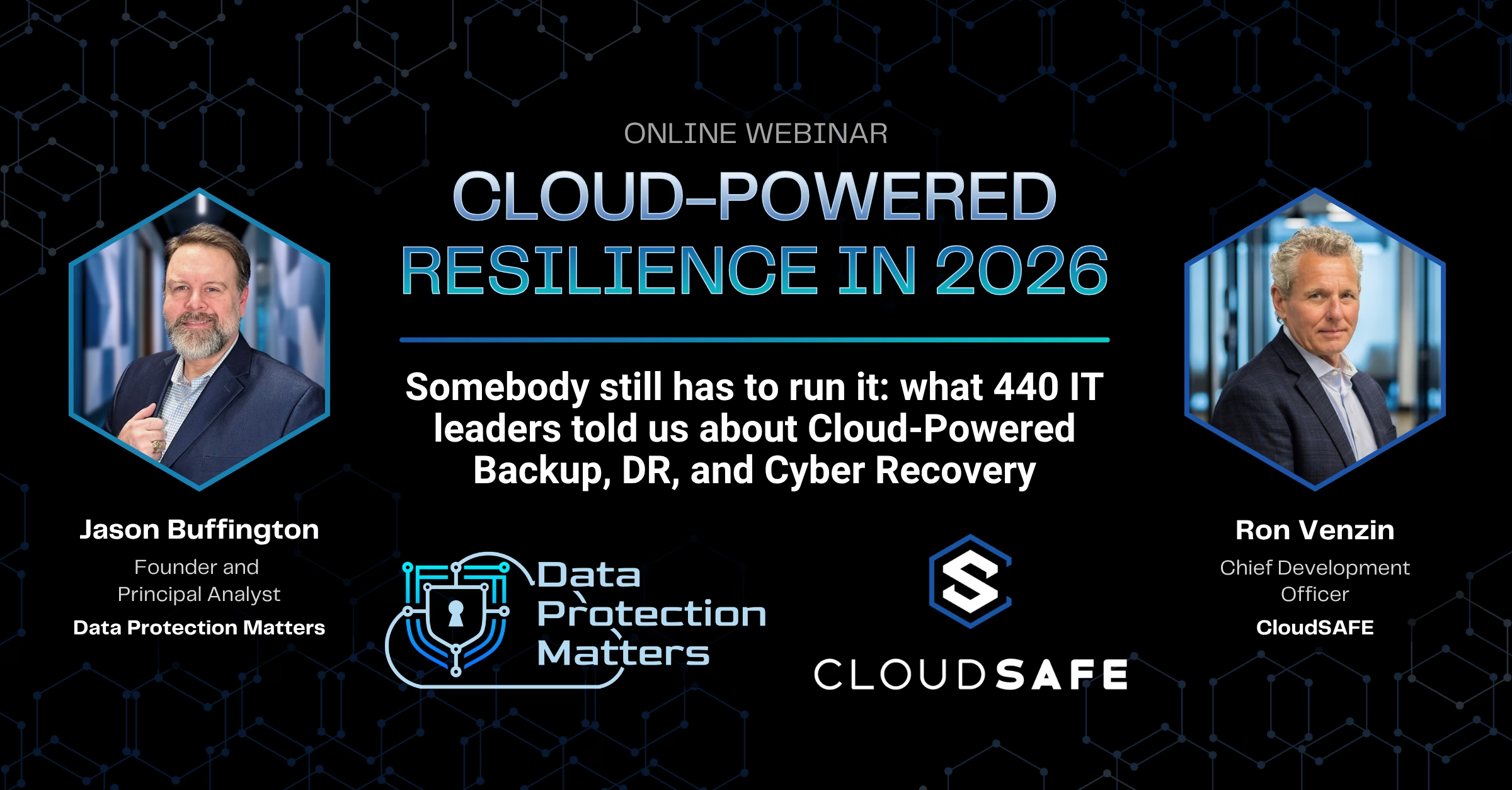
Recorded October 14, 2026. Presented by Jason Buffington, Founder and Principal Analyst at Data Protection Matters, and Ron Venzin, Chief Development Officer at CloudSAFE.
Overview
This webinar pairs independent research from Data Protection Matters (DPM) with CloudSAFE’s managed services offering. It asks why organizations turn to managed service providers (MSPs) for backup and disaster recovery, who manages those services today, and how organizations recover from disruption.
Ron Venzin, a Founder and the Chief Development Officer of CloudSAFE, brings more than three decades of cloud and managed services leadership, including six acquisitions as a founding partner of Focal Point Solutions Group. CloudSAFE has supported more than 500 customers over 15-plus years, operates nine North American data centers with a presence in Europe, hosts about 1,100 environments and reports 97% client retention. It serves manufacturing, healthcare, insurance and financial services organizations running IBM, Windows and Linux environments.
Jason Buffington represents DPM, an independent research firm with more than 35 years in backup, disaster recovery and cyber resilience. The webinar draws on two DPM studies: a fall 2025 survey of 502 business continuity and disaster recovery (BC/DR) leaders, and a spring 2026 survey of 440 IT leaders using backup and disaster recovery as a service (BaaS and DRaaS).
Watch the Full Webinar
Fill out the short form below to watch or download the recording.
Why Organizations Use an MSP
Organizations retain an average of 4.5 third-party services. Backup to a cloud provider leads at 68%, followed by security monitoring (64%) and threat intelligence (62%). Cloud storage as an offsite repository was the most used cloud backup capability (73%), followed by backup software running as a cloud service (67%). Hands-on help mattered too: 41% relied on troubleshooting by MSP engineers and 37% on assisted restores.
Ron’s framing is that this is a hybrid world. Backup and recovery need dedicated professionals, and containers, public cloud and AI demand ever more specialization. In Ron’s words, “You cannot keep a dedicated staff employed just in case.” CloudSAFE positions itself as a technology-agnostic provider across private, public and hybrid clouds.
Tool Sprawl and Cost Control
Organizations average 2.8 backup tools, and only 7% use a single solution for everything. Nearly half (48%) use a separate tool for SaaS applications. Ron asks whether teams are using best-of-breed tools or simply what staff already know, whether they can extend backup skills into high availability and DR, and who is watching cloud costs.
CloudSAFE’s answer is managed backup and recovery across public, private and hybrid environments, with tools such as BRMS and Veeam managed end to end. Its FinOps service works only from existing cloud billing data, with no agents and no downtime risk, and delivers a 12-month spend baseline and a roadmap sequenced by value.
Who Manages Backup: IT or MSP
Backup management remains mostly IT-led: 64% say their IT team manages it entirely or mostly, versus 22% who say an MSP does. Expertise drives both choices: IT-led organizations cite their own dedicated staff, while MSP-led organizations cite the provider’s deeper software and crisis-recovery experience. Among MSP benefits, 47% said MSPs support the overall solution better and 38% said it is more cost-effective.
CloudSAFE describes a three-stage cloud journey: backup as a service first, then DRaaS with proven recovery time and recovery point objectives (RTO and RPO), and finally the full enterprise estate. Provider responsibility grows at each stage. For public cloud, CORE is a fully managed AWS and Azure environment, while FLEX adds modular services to a cloud the customer already runs.
How Organizations Recover
Most organizations (78%) recover to a hyperscale cloud such as AWS or Azure, and 40% use a DRaaS provider. CloudSAFE delivers DRaaS for IBM i, AIX, Linux and Windows with defined RTOs, automated failover and audit readiness for HIPAA, PCI DSS and SOC 2.
When selecting a new provider, the top factors are cyber resilience and ransomware recovery (63%), proven recovery speed (53%) and integration with existing tools (42%). Current MSP customers rely most on cyber resilience expertise (63%) and DR planning expertise (56%). Cost ranked lower, at 22%.
Pain Points, Trigger Events and Budgets
The presenters map eight client pain points, from skill gaps to rising costs, to CloudSAFE responses. Common triggers for action include a major outage or security event, a hardware refresh, new compliance requirements and new IT leadership.
DPM’s budget shifts for 2026 show +6.7% for backup or IT-DR technologies and +5.8% for MSPs for backup and DR, ahead of BC/DR staff (+4.3%) and consultants (+4.2%). About two in three BC/DR leaders are engaged with the C-suite, but 34% report no interaction with their board.
Executive Buyer’s Checklist
CloudSAFE urges executives to “judge the partner, not just the feature list.” Its ten questions ask whether RTO and RPO are contractually guaranteed, when full recovery was last proven, whether ransomware can reach backups, what the all-in cost is and how cleanly a customer can exit. Because not every application needs the same RTO and RPO, Ron recommends a consultative partner to ensure requirements are met while keeping cost in mind.
Final Thoughts and Call to Action
The closing message is that “testing a backup recovery is the proof and standard versus guessing that everything should be fine.” CloudSAFE suggests executives make recovery provable, put a number on downtime and control cloud spend. The recommended next step is a no-cost, no-obligation high-level review, booked at cloudsafe.com, which offers an honest verdict on recoverability.