
When you see headlines about major cloud security breaches, the narrative often feels like a high-tech thriller. Advanced persistent threats, sophisticated hackers, zero-day exploits. But if you spend any time working inside cloud environments or responding to actual security incidents, you start to notice something uncomfortable: most of these breaches trace back to things that are embarrassingly simple.
The breaches aren’t the work of elite hacking teams exploiting undiscovered vulnerabilities, they were often oversights, misconfigurations, or poor credential management.
Security vendors will continue to pitch increasingly sophisticated tools, but the unfortunate reality is most organizations still haven’t mastered the fundamentals, and those fundamentals are exactly where breaches happen.
The Pattern That Keeps Repeating
If you work in cloud support long enough, you start seeing the same story play out over and over. Different companies, different industries, same script.
Cloud platforms like AWS, Azure, and Google Cloud give organizations incredible flexibility and power. You can build almost anything, which is both their greatest strength and their biggest risk. These platforms provide all the tools you need to architect secure, resilient systems. They also make it remarkably easy to create serious security vulnerabilities if you don’t know what you’re doing.
When you’re working in support roles at major cloud providers, you get a front-row seat to this reality. You see companies of all sizes making the same preventable mistakes. Storage buckets left publicly accessible. IAM policies that grant far more permissions than necessary. Security groups misconfigured to allow traffic that should be blocked. The pattern is so consistent it becomes predictable.
The scary part isn’t that these mistakes happen. It’s that they happen at organizations with significant resources, dedicated IT teams, and sometimes even partnerships with major managed service providers. If companies at that level are struggling with the basics, it suggests the problem runs deeper than individual competence.
The Three Failure Modes That Dominate Breach Post-Mortems
When you dig into what actually went wrong in most cloud breaches, three categories account for the vast majority of incidents.
Misconfigurations
This is the most common culprit. A setting gets toggled incorrectly during initial setup. A security control gets disabled temporarily for testing and never gets re-enabled. A resource gets deployed without proper access restrictions because someone was moving fast and assumed they’d come back to fix it later.
Cloud infrastructure is complex, and that complexity creates opportunities for mistakes. A single misconfigured resource can expose sensitive data or create an entry point for unauthorized access. The problem compounds when organizations don’t have systematic processes for reviewing configurations or when they rely on manual checks that inevitably miss things.
IAM Credential Management
Identity and Access Management failures are the second pillar of most breaches. This includes the obvious problems like weak passwords or credentials that get exposed in code repositories. But it also includes more subtle issues like permission creep, where user accounts accumulate more access rights than they need over time.
Cloud environments often start small and grow organically. A developer gets broad permissions to spin up resources during a project. Those permissions never get revoked when the project ends. Someone creates a service account for a specific integration but grants it admin-level access because it’s easier than figuring out the minimum required permissions. Multiply this across dozens or hundreds of users and service accounts, and you end up with an environment where it’s genuinely hard to know who has access to what.
Third-Party Provider Gaps
The third failure mode is perhaps the most frustrating because it represents a breakdown in accountability. Organizations hire managed service providers or work with third-party consultants to help manage their cloud infrastructure. These providers often have broad access to production environments. But if those providers don’t have strong governance policies or security practices, they become the weak link.
The publicly reported data breach in South Korea for a major quick service restaurant chain is a perfect example. While details were scarce on the exact root cause, it was reported to have been linked to inconsistent governance policies set by a third-party vendor. The company itself had presumably chosen a reputable partner, but that partnership still resulted in exposed PII data and legal consequences.
This pattern reveals a critical problem: many third-party providers simply don’t have the same stake in your security posture that you do. They’re focused on delivering the specific work they were contracted for. Your security is important insofar as it affects their reputation, but it’s not their primary business outcome. This misalignment creates risk that’s hard to manage through contracts alone.
Why More Tools Won’t Fix This
When organizations experience a breach or near-miss, the instinct is often to look for better security products. More sophisticated monitoring. Advanced threat detection. AI-powered anomaly identification.
These tools have their place, but they don’t always address the right problem. You don’t need better tools to detect breaches caused by storage buckets configured to allow public access. You need processes that prevent those buckets from being misconfigured in the first place.
The challenge is compounded by a competency gap in the managed services market. Many providers offering cloud management services don’t actually have deep expertise in cloud security fundamentals. They can provision resources and handle basic administration, but they may not understand the security implications of the configurations they’re implementing.
This creates a false sense of security. Organizations believe they’re protected because they’ve hired a managed service provider. But if that provider doesn’t have strong practices around IAM management, configuration auditing, and governance, the organization is still exposed.
The fundamental issue is that security can’t be bolted on after the fact. You can’t layer sophisticated detection tools on top of poor foundations and expect good outcomes. The sophisticated tools might help you detect breaches faster, but they’re not preventing the breaches from happening in the first place.
What Actually Works: Secure by Default
The alternative approach is to build security into the foundation of your cloud environment from day one. This means making certain practices non-negotiable rather than optional best practices.
Five foundational pillars need to be rock-solid in any cloud environment:
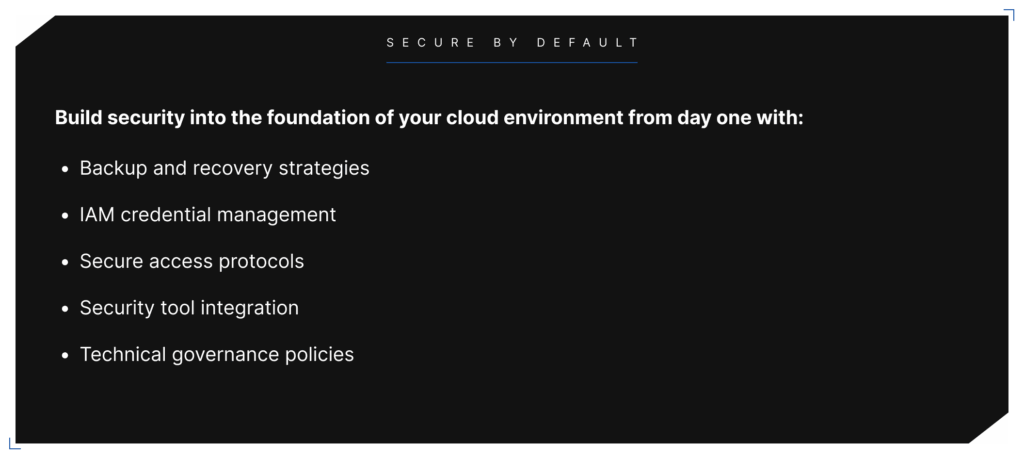
Backup and recovery strategies ensure you can restore operations even if something goes wrong. This isn’t just about having backups, it’s about having tested, reliable backup processes that you trust will work when you need them.
IAM credential management means following the principle of least privilege religiously. Every user, every service account gets exactly the permissions they need and nothing more. This requires more upfront work, but it dramatically reduces your attack surface.
Secure access protocols control how people and systems connect to your infrastructure. This includes VPNs, bastion hosts, and multi-factor authentication, not as nice-to-haves but as mandatory requirements.
Security tool integration means deploying the right monitoring and detection capabilities, but doing so in a way that complements your strong foundations rather than compensating for weak ones.
Technical governance policies establish guardrails that align with cloud provider best practices. These aren’t business governance policies about approval workflows. They’re technical policies that define how resources can be configured and what security controls must be in place.
The key insight is that these pillars need to be built into your environment as default behaviors, not implemented reactively after you discover gaps. When security controls are optional, they eventually get skipped during busy periods or when someone is trying to move quickly. When they’re mandatory and baked into your infrastructure patterns, they just happen automatically.
This “secure by default” philosophy prevents wrong actions from being possible in the first place. If your infrastructure patterns don’t allow public storage buckets to be created without explicit overrides and approvals, you can’t accidentally expose data by misconfiguring one. If your IAM policies enforce least privilege by default, developers can’t grant overly broad permissions just because it’s easier.
Evaluating Your Current Posture
If this article has you wondering about your own environment, there are some straightforward questions you can ask to assess your risk.
Start with the basics: Can you confidently list every user and service account with access to your production environment? Do you know exactly what permissions each has? When was the last time you audited these permissions and removed access that’s no longer needed?
Look at your infrastructure: Could someone on your team accidentally deploy a resource with insecure configurations? Are there guardrails preventing common mistakes, or is security dependent on individual engineers knowing and following best practices every time?
Examine your backup and recovery capabilities: When did you last test restoring from backup? Not just verifying that backups exist, but actually performing a restore to confirm the process works? How long would it take you to recover operations if you needed to?
If you’re working with managed service providers or third-party consultants, dig into their practices: Do they have documented governance policies specifically for cloud security? Do they enforce least privilege access? Can they demonstrate how they prevent misconfigurations rather than just detecting them after the fact?
These questions reveal whether your security posture is built on hope and best intentions or on systematic controls that prevent failures.
The Path Forward
Cloud breaches make headlines because of their scale and impact, but in most cases, the root causes are preventable. The sophisticated attack narratives are often just convenient stories that obscure more mundane realities: organizations didn’t get the basics right, third-party providers lacked accountability, or security was treated as something that could be addressed later.
The good news is that fixing this doesn’t require revolutionary approaches. It requires commitment to doing foundational work correctly. It means choosing partners who view security as a prerequisite rather than a feature. It means building environments where doing the right thing is the default path, not the harder path that requires extra effort and vigilance.
Because at the end of the day, you don’t need to defend against every possible sophisticated attack vector. You need to stop making the basic mistakes that cause most breaches in the first place.
Frequently Asked Questions
What’s the most common cause of cloud security breaches?
A: Misconfigurations are the leading cause of cloud breaches, accounting for the majority of incidents across all major cloud platforms.
Are cloud breaches usually caused by sophisticated hackers?
A: No, most cloud breaches result from basic mistakes like misconfigurations, poor credential management, and inadequate governance rather than advanced cyberattacks.
How can I tell if my managed service provider has strong cloud security practices?
A: Ask whether they enforce technical governance policies aligned with cloud best practices, implement least-privilege IAM access by default, and can demonstrate how they prevent common misconfigurations rather than just detecting them after deployment. A competent provider should have documented processes for security auditing, regular credential reviews, and tested backup recovery procedures. If they can’t clearly articulate how they build security into infrastructure from day one, that’s a significant red flag.
What does “secure by default” actually mean in practice?
A: Secure by default means building cloud environments where security controls are mandatory and automatic rather than optional best practices. This includes infrastructure patterns that prevent insecure configurations from being deployed, IAM policies that enforce least privilege access without requiring manual oversight, and governance guardrails that align with platform security recommendations. The goal is making it impossible to accidentally do the wrong thing rather than relying on people to consistently remember to do the right thing.
Why do third-party providers create security risks?
A: Third-party providers often have broad access to your cloud environment but may lack strong governance policies or security practices, and their business incentives don’t always align with your security outcomes.
Should I focus on buying more security tools?
A: Not if your foundational security practices aren’t solid; advanced tools can’t compensate for poor IAM management, misconfigurations, or lack of governance policies.
How often should I audit IAM permissions in my cloud environment?
A: Organizations should conduct comprehensive IAM audits at least quarterly, with continuous monitoring for high-privilege accounts and automated alerts for permission changes. Best practice includes reviewing access rights whenever employees change roles, projects end, or service accounts are no longer actively used. Many breaches happen because permissions granted for temporary projects remain active indefinitely, creating unnecessary risk. Regular audits help identify permission creep before it becomes a security liability.
What’s the difference between business governance and technical governance policies?
A: Business governance policies address organizational workflows like approval processes and budget controls, while technical governance policies define how cloud resources must be configured to meet security and compliance requirements. Technical governance includes specifications like mandatory encryption standards, required security group configurations, backup retention policies, and IAM permission boundaries. These technical policies map directly to cloud platform best practices and create enforceable guardrails that prevent insecure deployments regardless of who’s doing the work.